Posts

Raymond Tanghe on Québec libraries and librarianship, 1952–1962

Image
Pour un système cohérent de bibliothèques au Canada français by Raymond Tanghe. Montréal: Fides, 1952, 38 p. Le bibliothécariat by Raymond Tanghe. Montréal: Fides, 1962. 117 p. Raymond Tanghe c.1960   Raymond Tanghe Raymond Tanghe (portrait at right c.1962) was born in France in 1898 and came to Canada in 1920 after serving in the French army during the First World War. He was an academic by choice and earned a PhD at the Université de Montréal in 1928.  His professional writings focused on human and economic geography, especially urban planning, at the l’École des Hautes Études Commerciales de Montréal in the 1930s. He became a professor and later Director of the central library of the Université de Montréal from 1942 to 1953. He had a flair for popular and scholarly writing and worked with Radio-Canada during the Second World War. Tanghe worked to centralize holdings at the University and expressed his opinion that it would benefit faculty and students at the Quebec Librar...
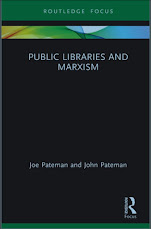
Public Libraries and Marxism by Joe and John Pateman (2021)

Image
  Public Libraries and Marxism by Joe Pateman and John Pateman. London and New York: Routledge, 2021. 119 p., indexed. Public libraries offer an amazing range of information and services in Western society, but to what end? Library organizations and librarians mainly focus on the functional aspects of library services and professional activities while ignoring power relationships and the institutional framework of libraries within society. Public Libraries and Marxism analyzes the public library from a Marxist perspective by challenging our conventional liberal-democratic views that focus mostly on delivering services while ignoring its hegemonic basis of authority. John Pateman has extensive administrative experience. He headed libraries in the UK before he came to Canada in 2012 to be the CEO of Thunder Bay Public Library in Ontario. He has written articles and books with a Marxist viewpoint, such as Public Libraries and Social Justice (2010) and Developing Community Led Publi...

Four Library Development Reports in British Columbia, 1945 to 1956

Image
Programme for Library Development in British Columbia . Victoria, B.C.: Joint Committee on Library Policy, 1945. 36 p. maps Programme for Library Development in British Columbia, 1950: Being a Condensation and Revision of the “Programme for Library Development in British Columbia,” 1945 . Victoria, B.C: Joint Committee of the British Columbia Library Association and the Public Library Commission, 1950. 10 p. Survey of Union Libraries in British Columbia . Victoria, B.C.: British Columbia Public Library Commission, 1950. 59 p. Programme for Library Development in British Columbia, 1956 . Victoria: British Columbia Public Library Commission, 1957. 15 p. (cover illustration below) Over the course of a decade following the Second World War, British Columbia trustees, officials, and librarians sought to improve library services across the province. The provincial Public Library Commission (PLC, est. 1919), in conjunction with financing from the Carnegie Corporation, had issued two previous ...

Library Service in New Brunswick (1953) by Peter Grossman

Image
Library Service in New Brunswick: A Report and Recommendations by Peter Grossman. Fredericton: New Brunswick Department of Education, 1953. 62 p., maps, illus. Peter Grossman, c.1953   For many years in the first part of the 20th century, public library service lagged in the province of New Brunswick; however, in 1951 a provincial Library Association was established with Maurice Boone, the chief librarian of the Legislative Library and formerly librarian of Acadia University, elected as President. The Association pressed government officials to improve public library services, and in the following year the Department of Education invited Peter Grossman, the Director of Libraries for Nova Scotia, to conduct a survey throughout the province and devise a plan for future library development. Peter Grossman, a native British Columbian with experience in regional libraries in the Fraser Valley and Vancouver Island, spent five weeks in the summer of 1952 investigating school, governme...

Ontario Libraries: A Province-Wide Survey and Plan, 1965 by Francis R. St. John

Image
St John, (Francis R.) Library Consultants, Inc.  Ontario Libraries: A Province-Wide Survey and Plan , 1965. Toronto: Ontario Library Association, 1965. 182 p. At the beginning of the 1960s, Ontario’s public, school, university, government, and special libraries were trying to cope with a rapidly growing population, changing technology, and staff shortages. The Department of Education had made a few incremental improvements after the Wallace Report of 1957, but leaders in the library sector expected more effective planning and financial support from Queen’s Park. When William Davis, the Conservative M.P. from Peel County, was appointed Minister of Education in 1962, the Ontario Library Association (OLA) invited him to speak at its 1963 conference. The new Minister did not disappoint: he spoke about the importance of libraries as community agents and stressed that better planning was necessary to achieve their service goals. Most importantly, he offered to finance studies sponsor...

Report on Provincial Library Service in Ontario by W. Stewart Wallace (1957)

Image
Report on Provincial Library Service in Ontario by W. Stewart Wallace. Toronto: Ontario Department of Education, January 1957. 62 p. with six appendices published between 1944 and 1955. By the early 1950s, the plans originally made for postwar library reconstruction ideas had only been partially achieved in Ontario and Canada. Passage of the National Library Act of 1952 and the official recognition of W. Kaye Lamb as National Librarian were the most successful endeavours. After 1945, the Ontario Library Association (OLA) relied on briefs and presented development plans based on ideas prevalent during the war’s reconstruction phase. The Ontario Department of Education had improved its grant formulas and regulations, introduced certification of librarians, amended older legislation, and added staff to its provincial library branch directed by Angus Mowat. Despite these improvements for local services, there was evident disenchantment with the 1946 grant formula that issued lesser am...

In Solidarity: Academic Librarian Labour Activism and Union Participation in Canada (2014)

Image
In Solidarity: Academic Librarian Labour Activism and Union Participation in Canada edited by Jennifer Dekker and Mary Kandiuk. Sacramento, California: Library Juice Press, 2014; viii, 355 p., illus. Collective action by faculty and librarians and their diverse organizations and associations has traditionally dealt mostly with academic standards and professional goals. With respect to economic issues, professors and librarians historically have engaged in individualistic pursuits. Until the 1970s, focused work to improve economic conditions was not considered an appropriate activity for university or college faculty and librarians. The spectre of “trade unionism” loomed large at many campus meetings aimed at discussing collective action and improving salaries and working conditions. A further complication during this formative period—librarians’ predilection for creating associations no matter how small in membership—also impeded coordinated action towards certified and non-certified ...