Posts

Showing posts with the label ontario library association

One Place to Look; The Ontario Public Library Strategic Plan (1990)
Image
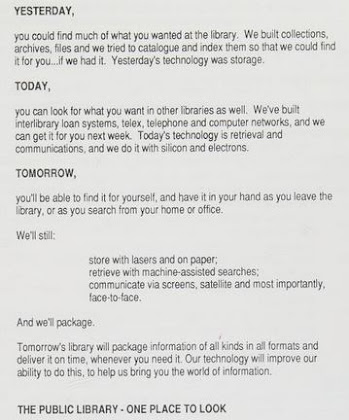
One Place to Look; The Ontario Public Library Strategic Plan . Prepared by the Ontario Public Library Strategic Planning Group. Toronto: Ontario Ministry of Culture and Communications, 1990. 68 p., illus. Also published in French with title: Une voie d'accès à l'information . Planning for Public Libraries in Ontario Soon after the passage of the seminal Public Libraries Act in 1985 by the Progressive Conservative government in Ontario, provincial library planners in the Ontario Library Association (OLA) began focusing on information policy and strategic planning in 1987. The strategic plans which the newly formed provincially-funded Ontario Library Service (OLS) areas began after 1989 were limited in scope, and, as a result, librarians and trustees from municipalities, the OLA, and professional groups began to concentrate on all of Ontario. An agreed upon strategic vision for all types of libraries would further cooperative work and develop consistency and direction that was ab...

Report on Provincial Library Service in Ontario by W. Stewart Wallace (1957)

Image
Report on Provincial Library Service in Ontario by W. Stewart Wallace. Toronto: Ontario Department of Education, January 1957. 62 p. with six appendices published between 1944 and 1955. By the early 1950s, the plans originally made for postwar library reconstruction ideas had only been partially achieved in Ontario and Canada. Passage of the National Library Act of 1952 and the official recognition of W. Kaye Lamb as National Librarian were the most successful endeavours. After 1945, the Ontario Library Association (OLA) relied on briefs and presented development plans based on ideas prevalent during the war’s reconstruction phase. The Ontario Department of Education had improved its grant formulas and regulations, introduced certification of librarians, amended older legislation, and added staff to its provincial library branch directed by Angus Mowat. Despite these improvements for local services, there was evident disenchantment with the 1946 grant formula that issued lesser am...

Intellectual freedom statement adopted by Ontario Library Association in 1963

Image
Ontario Libraries and Censorship Throughout the 1950s and early 1960s, the Ontario and Canadian library associations formed specific committees to address the issue of obscene literature and censorship. At mid-century, many librarians reasoned they were selecting books, not prohibiting access or advocating freedom. They worked within an environment where Canadian law did not always ensure civil rights and liberties for everyone. In this situation, library neutrality was often cited as the best course, although the practice of outright exclusion and restricting access to steamy novels by request was not uncommon. Most librarians believed in the concept of treating patrons equally and providing resources representing multiple viewpoints. During this period, the general stance of both associations was to issue reminders that self-censorship by librarians in book selection was often a greater threat to intellectual freedom than actions by external local groups, governments, or federal laws...

Mabel Dunham: Librarianship as a Profession for Women, May 1921

Image
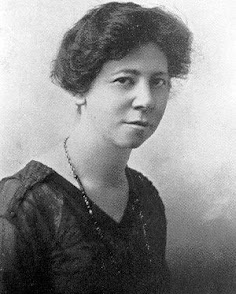
    At the end of her year as president of the Ontario Library Association in March 1921, B. Mabel Dunham, the chief librarian of the Kitchener Public Library since 1908, selected a topic of major importance at the OLA’s twenty-first meeting: “Library Work as a Profession for Women.” For the most part, press reports shortened the topic by omitting “for Women” but briefly reported her main remarks. Library journals, such as Public Libraries , which covered the meeting in its May issue, had little to say about Dunham’s speech. It reported, “Miss Dunham’s paper was a very able plea for library work as a means of service to the community and development of one’s highest personality.” The Library Journal reported that “Miss Dunham ranks library work as one of the high callings for women, inasmuch as it presents an opportunity for service to the community and for building up one’s own character and personality.” The synopsis in the May issue of the Ontario Library Review obse...

Presidential speech by Mary J.L. Black to the Ontario Library Association, 1918

Image
Mary J.L. Black becomes President of the Ontario Library Association 1917–18   On April 10, 1917, Mary J.L. Black was elected president of the Ontario Library Association (OLA). She was the first female to hold this position. In the first part of the twentieth century, presidential positions for women in Anglo-American library associations were unusual. Theresa Elmendorf was elected president of the American Library Association in 1911, followed by Mary Wright Plummer in 1915. It was not until half a century later, in 1966, that the Library Association (UK) elected Lorna Paulin president. Mary Black and Helen Gordon Stewart, who was elected president of the British Columbia Library Association in September 1917, were the first women to break the presidential gender barrier in Canadian librarianship. Their executive offices came in the same year that women over the age of 21 who were born or naturalized British subjects became legally eligible to vote in provincial elections. Black ...

Marshall McLuhan speaks to Ontario librarians about books and media, 1954–56

Image
Herbert Marshall McLuhan, 1945  By the mid–1950s, prominent speakers had become a fixture at Ontario Library Association (OLA) annual conferences. Such was the case in mid-May 1956 when the OLA met at Oshawa’s new McLaughlin Library, which had opened in 1954. This OLA conference was shortened to two days because the Canadian Library Association would meet at Niagara Falls in June. Nevertheless, four hundred and twenty-five persons registered; it was one of the best attended conferences to date. A notable attraction was an emerging University of Toronto professor at St. Michael’s College, Marshall McLuhan. Marshall McLuhan Addresses Librarians about the Future of the Book in Oshawa, 1956 After he began teaching and researching, McLuhan started to articulate how new electronic media would fundamentally change the role of traditional printed publications and how institutions, such as libraries, would respond to these shifts. He addressed delegates about “The Future of the Book” at a...

Short History of Ontario Library Boards and Trustees

Image
Betty Butterill, n.d. I had an opportunity to speak at OLA's most recent Super Conference in Toronto. It was the twenty-fifth anniversary of the revamped annual OLA conference! OLA's restructuring of its various annual meetings and sub-conferences in the mid-1990s has been highly successful for the library community and its trade show, attracting attention from across Canada, not just the province of Ontario. Anyway, I was speaking at a session designed on "governance" mostly aimed at library trustees but also of some interest to librarians and people interested in libraries as well. I am posting a PDF version of a PowerPoint that I used to talk about a "short history" of Ontario's public library movement, its trustees, legislation, the OLA itself, and some main trends that have absorbed people's attention over the past century. The history of libraries in Ontario does not usually focus on library boards or trusteeship or the OLA's impact but i...

ONTARIO LIBRARY ASSOCIATION CONSTITUTION, 1901

Early in the twentieth century a small group of trustees, librarians, and persons interested in libraries met in Toronto at the Ontario Education Department's Normal School located on St. James Square (present-day Ryerson University). They planned to form an association to promote public library development in Ontario, despite the their small numbers--just more than thirty attendees. The delegates elected James Bain, Jr., chief librarian of the Toronto Public Library as President of the Ontario Library Association. He read an inspiring paper, "The Library Movement in Ontario." The new Secretary from Lindsay, Edwin A. Hardy, gave a more pragmatic paper, "An Outline Programme of the Work of the Ontario Library Association." Both men would be instrumental in the following years in which the OLA would vigorously promote public libraries and become one of the most successful library associations in North America. Other presentations focused on Canadian literature a...

Public Library Boards in Postwar Ontario by Lorne and Karen Bruce (2012)

Image
Karen and I have just reissued a revised and enlarged edition of our older Public Library Boards in Postwar Ontario , 1945-1985 . It was originally published in 1988 as an occasional paper by the University of Dalhousie School of Library and Information Science. Long out of print. But now it is back in print with updated information for the original text and references, plus a new chapter to continue the story from 1985 to just before 2010. Most of the original text has been retained. Contemporary library boards in Ontario are mostly administrative entities, but this was not always the case. Local government today is very different from the pre-1945 era. Over the years, accountability has trumped representation (a political concept) in local government and provincial statutes controlling local agencies. The municipal government has overtaken many local bodies—clearly, elected local officials in larger government entities created after the 1960s in restructuring exercises now hold po...